Missives

A collection of apologetic and encouraging notes for Christians in need of some power-boosts from time to time.

5 years ago, in 1947 at Bethlehem, two Bedouin shepherds walked into Kando's cobbler shop with four rolls of parchment in hand.

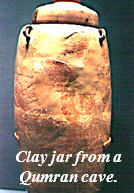
75 years ago, in 1947 at Bethlehem, two Bedouin shepherds walked into Kando’s cobbler shop with four rolls of parchment in hand. Jum’a and Muhammed ed-Dib found 7 scrolls in a cave near the Dead Sea (pics below), stored inside tall ceramic jars (picture, bottom right). Unaware of their true value, they sold the parchments to Kando, who was a cobbler and antiquities dealer. Although Kando couldn’t read the letters on the parchment, they resembled ancient Syriac writing he’d seen in Bethlehem’s Orthodox Church. He offered the scrolls to Archbishop Samuel, who purchased them for 24 Palestine pounds – about $100 at the time. In June 1954 all the scrolls appeared for sale through an ad in The Wall Street Journal, and Israel purchased them. [1]
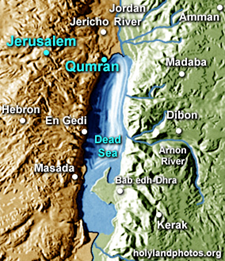
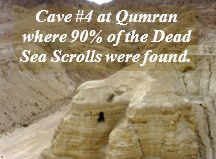
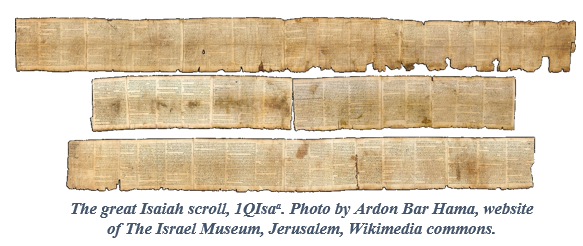
In total, the ‘Dead Sea Scrolls’, as they began to be called, are a collection of ~1,000 manuscripts, preserved in over 25,000 fragments. (The scrolls were broken up by other Bedouins whom archaeologists agreed to pay ‘by the square inch’ for any scrolls they found.) The texts include every book of the Hebrew Bible except possibly Esther, as well as unique sectarian writings. They were written between the 3rd century BC to 1st century AD. The scrolls pre-date all other known biblical writings (such as the Hebrew Masoretic Text and the Greek Septuagint) by at least 1,000 years.  40% are Hebrew scripts (e.g., the famous Isaiah scroll), 30% are non-canonical texts (e.g., the Book of Enoch), and 30% sectarian manuscripts (e.g., the Community Rule book).  Most manuscripts were written in Hebrew, some Aramaic and Nabataean, and a few in Greek.
There is debate about the authors’ identity. Pliny the Elder (a geographer writing after the fall of Jerusalem in 70 AD) describes a group of Essenes, a Jewish sect, living in a desert community on the northwest shore of the Dead Sea near the ruined town of Ein Gedi.  Most today connect the scrolls with that Essene community who lived at Qumran. The scrolls, then, would have been their library. The arid, remote environment around Qumran was well suited for the Essenes, who sought to remove themselves from society to live pure, righteous lives in accordance with a strict interpretation of Jewish law. We see from their writings that they anticipated eschatological events, the end of days. They believed that the promised Messiah would soon return, overthrow a corrupt society, and usher in the kingdom of God. [2]

Scholars find remarkable continuity between the scrolls and later copies, such as the Masoretic Text, even though the scroll is a textbook example of an inferior copy due to numerous scribal pens and overwrites. Gleason Archer wrote: “Even though the two copies of Isaiah discovered in Qumran Cave 1 near the Dead Sea in 1947 were a thousand years earlier than the oldest dated manuscript previously known (980 AD), they proved to be word-for-word identical with our standard Hebrew Bible in more than 95% of the text. The 5% variation consisted chiefly of obvious slips of the pen and variations in spelling.” [3]  God’s faithfulness is well attested!
Like this? Consider sharing it to Facebook by clicking the linked icon below.
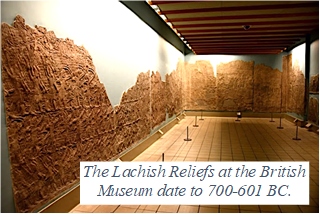
King Sennacherib constructed a "Palace Without Rival" at his new capital city Nineveh where he chronicled his battlefield successes.

Condensed from Lachish.org, and adapted by Bro. Vince Kluth


King Sennacherib constructed a “Palace Without Rival” at his new capital city Nineveh where he chronicled his battlefield successes.  One building’s inner space was accessible only by the family and senior court officials. Immense guardian figures loomed over a passageway leading to 8’ high by 80’ long battle scenes carved on the walls. Sir Austen H. Layard discovered and sent them to the British Museum in 1851 (see below).  These bas-relief panels were meant to impress foreign emissaries and dignitaries awaiting an audience with the king, and to warn those close to him of the king’s absolute control.

The events depicted took place in 701 BC during the king’s third campaign along the Phoenician coasts and against the cities of Philistia and Judea, during which he defeated the Egyptian army and laid siege to King Hezekiah’s defense cities near Jerusalem. Isaiah chapter 36 chronicles his attack while Sennacherib’s successes against Lachish are recounted on stone and clay cylinders and prisms found at Nineveh, providing unique correlation among the biblical texts, contemporary Assyrian documents and excavated evidence.

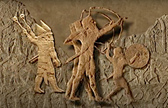
Starting from the left, one views rows of Assyrian archers, slingers and spearmen (emphasized, left) moving toward the city.

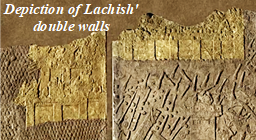
Lachish is depicted as a hilltop fortress, having double side walls with turrets and battlements with square windows (colored, below).  All these features have been verified through excavations at tel Lachish.


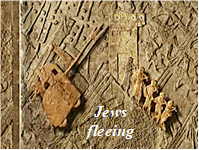
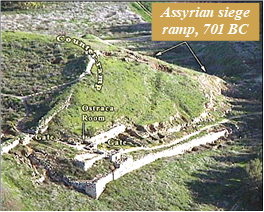
As townspeople flee the city down the roadway leading from the town gate, Lachish is attacked by Assyrian siege engines and ramps (see left). This huge ramp has actually been found against the walls of the city ruins (see below).

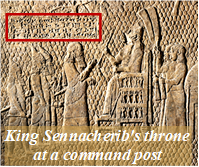
The next battle scene shows prisoners, deportees and captured goods brought before Sennacherib, who is seated at his command post (see below) on a neighboring hilltop where the king oversaw the destruction of Lachish.  The cuneiform inscription (red box, inset) tells us “Sennacherib, king of the world, king of Assyria, set up a throne while the booty of Lachish passed before him.” Note that his face has been chipped out, presumably by a later adversary.  At the foot of the hill (not shown here), the king’s chariot awaits along with a line of soldiers and booty that includes symbols of state, such as the governor’s thrones, his chariot and scepter.  It’s perhaps from this campsite throne that Sennacherib received the message sent by Hezekiah then huddled in a besieged Jerusalem and mentioned in 2 Kings 18:14, Hezekiah king of Judah sent to the king of Assyria to Lachish, saying, I have offended; return from me: that which thou puttest on me will I bear. The biblical passage then tells us that Sennacherib accepted heavy tribute from Hezekiah.

However, what’s most telling is what’s missing; namely, the king could only brag about taking Judah’s number 2 city, not the capital of Jerusalem.  Though his mighty army surrounded Jerusalem, he didn’t count on one angel destroying 185,000 of his men. On the Sennacherib cylinder, he boasts “Hezekiah the Judahite I shut up like a caged bird in Jerusalem”.  Another clay cylinder notes his death by one son, but Isaiah 37:38 says both.  Seems to me that God’s record is more truthful.


Sources: Lachish.org, ThinkingToBelieve.com.

Like this? Consider sharing it to Facebook by clicking the linked icon below.
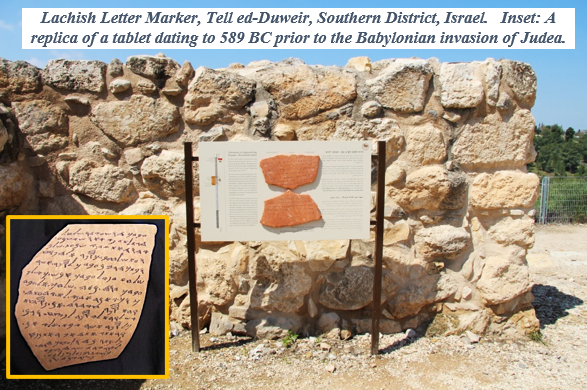
Between 1935-38, James L. Starkey dug around an old gate into two feet of ash and debris and unearthed 18 pottery sherds written in black carbon ink at the Lachish excavations.

Between 1935-38, James L. Starkey dug around an old gate into two feet of ash and debris and unearthed 18 pottery sherds written in black carbon ink at the Lachish excavations (picture, below). Archaeologists were excited because it provided a pre-exile form of ancient Hebrew script. Bible students were equally excited because the content parallels the Bible’s record of public opinion on Jeremiah’s messages.

Historically, Jeremiah prophesied 41 years in Jerusalem from the reign of king Josiah until the deportation of king Zedekiah into Babylon. As a prophet and priest, he stood practically alone with his message of doom: because of Manasseh’s sinful abominations, Judah will surely fall to the Babylonians. Defect to king Nebuchadnezzar and live. Resist and die of the sword and famine in the city which will burn with fire. Needless to say, he was hated by all: pastors, priests, princes, the people, and certainly the false prophets declaring a sure victory. Though they heard his message, they took it the wrong way: the princes said unto the king, We beseech thee, let this man be put to death: for thus he weakeneth the hands of the men of war that remain in this city, and the hands of all the people, in speaking such words unto them: for this man seeketh not the welfare of this people, but the hurt.

Map showing location of Jerusalem's two important southern defense cities.

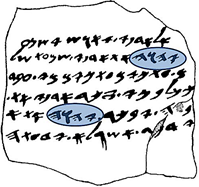
Elsewhere, at a southern Judean military outpost, a soldier named Hoshaiah writes a report on clay tablets to his commander Yaosh stationed at the defense city of Lachish, informing him that: (i) the Babylonians are attacking, (ii) he cannot see the signal fire at Azekah, one of two remaining defense cities (cp. Jer. 34:7, see right); and (iii) an army commander has been sent to Egypt (cp. Ezek. 17:15-16).  The soldier often appeals to YHWH (see picture below), and mentions others such as Elnathan,  Jaazaniah, Neriah, and Gemariah — all biblical names of that time period (cp. Jer. 36:12, 35:3; 32:12; 36:10).  Even Hoshaiah’s name is in the Bible (cp. Jer. 42:1) but may not be the same man.

Lachish Letter II.  The divine name YHWH (Yahweh, or Jehovah) is circled.

Most striking is his complaint of Jeremiah’s words in Letter 6: “Read, I pray thee, and (thou wilt) see (that) the words of the [prophet*] are not good, (liable) to weaken the hands, [to make] sink the hands of the coun[try and] the city.”  Some speculate “the prophet” to be Urijah who had a similar gloomy message (cp. Jer. 26:20), but he lived long before the Babylonian assaults.  A fragment from a different tablet specifies “[…i]ah the prophet”, while another says “[Je]remiah”.

It is a rare treasure to find official Judean military letters, replete with period-specific names plus a reference to a major Bible prophet, during an intense time of Hebrew history.  The writer’s emotions, concerns, fear and sense of duty all sparkle from the hardened clay.

If only they had listened to Jeremiah.  Is it any different today?


*Secular archaeologists translate “prophet” as “officers” in Letter 6.

Sources: Nabatea.net, ADefenseOfTheBible.com, and Bible Reading Archaeology. The first source is highly intriguing and worth reading.

Like this? Consider sharing it to Facebook by clicking the linked icon below.

When you are forgotten, or neglected, or purposely set at naught, and you don't sting and hurt with the insult or the oversight, but your heart is happy, being counted worthy to suffer for Christ, THAT IS DYING TO SELF.

When you are forgotten, or neglected, or purposely set at naught, and you don’t sting and hurt with the insult or the oversight, but your heart is happy, being counted worthy to suffer for Christ, THAT IS DYING TO SELF.

When your good is evil spoken of, when your wishes are crossed, your advice disregarded, your opinions ridiculed, and you refuse to let anger rise in your heart, or even defend yourself, but take it all in patient, loving silence, THAT IS DYING TO SELF.

When you lovingly and patiently bear any disorder, any irregularity, and unpunctuality, or any annoyance; when you can stand face to face with waste, folly, extravagance, and spiritual insensibility, enduring it as Christ Jesus endured it, THAT IS DYING TO SELF.

When you no longer care to hear yourself in conversation, or to record your own works, or itch after commendation, when you can truly love to be unknown, THAT IS DYING TO SELF.

When you see your brother prosper and have his needs met, and can honestly rejoice with him in spirit and feel no envy nor question God, while your own needs are far greater and you are in far more desperate circumstance, THAT IS DYING TO SELF.

When you can receive correction and reproof from one of less stature than you, and can humbly submit inwardly as well as outwardly, finding no rebellion or resentment rising up within your heart, THAT IS DYING TO SELF.

Like this? Consider sharing it to Facebook by clicking the linked icon below.

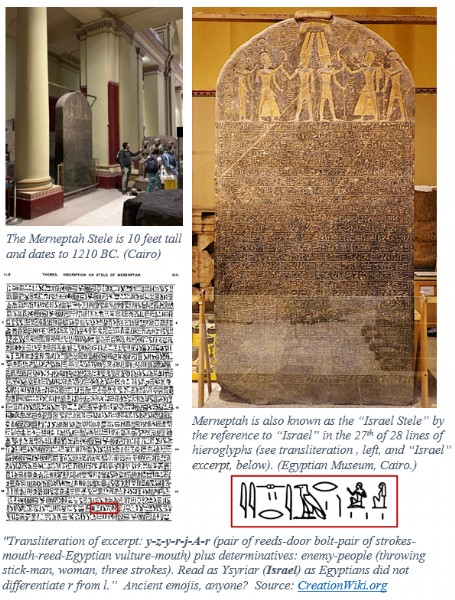
Definitive snapshots of history reaching far back in time remain elusive but super exciting when found. One of biblical archaeology's top-ten discoveries is a 10-foot-tall grey granite slab. Mr. Windle of ABR gives a succinct overview, leaving space for more pictures to admire.

Definitive snapshots of history reaching far back in time remain elusive but super exciting when found.  One of biblical archaeology’s top-ten discoveries is a 10-foot-tall grey granite slab.  Mr. Windle of ABR [1] gives a succinct overview, leaving space for more pictures to admire.

“The most famous, and arguably the most important, discovery related to Moses and the Exodus is the Merneptah Stele. In ca. 1208 BC Pharaoh Merneptah erected a 10-foot-tall victory monument (called a ‘stele’; see photos) in a temple at Thebes to boast of his claims of victory in both Libya and Canaan. It was discovered in 1896 by Sir Flinders Petrie. On it, Merneptah boasts, ‘Israel is wasted, its seed is not; and Hurru [Canaan] is become a widow because of Egypt.’  The inscription likely refers to a small campaign into Canaan (only three cities were taken), and despite Merneptah’s boast, Israel was not destroyed.”

“Most scholars agree that this is the oldest definitive reference to Israel as a nation outside of the Bible, and certainly the clearest Egyptian reference to Israel. It is also important because it points toward an early date for the exodus (ca. 1446 BC) and not the late date that some scholars hold to (ca. 1270 BC). It is doubtful that there would be enough time from 1270 BC to 1208 BC to account for the Exodus, the 40 years of wandering in the desert, the seven-year Conquest of Canaan, the settlement of the tribes in their territories, and the establishment of a national presence in the land, all before Merneptah claims to have conquered the Israelites. Merneptah’s Canaanite campaign instead likely dates to the time of the Judges, when the nation of Israel was already settled in Canaan. The Merneptah Stele is evidence that the Exodus from Egypt, led by Moses, took place in the 15th century BC as the biblical data indicates.”

“These [and other] discoveries indicate that the accounts of Moses and the Exodus are based in real history. … They provide circumstantial evidence … to reasonably conclude that the people of Israel were slaves in Egypt at the time the Bible indicates. Further, the archaeological data suggests that the Israelites left suddenly and were settled in Canaan by the end of the 15th century BC, in line with the biblical data.”

Like this? Consider sharing it to Facebook by clicking the linked icon below.

This week I received two nice letters along with much literature from Joyce Fisher, a 93-year-old widow in El Cajon, California. Ed and Joyce were always evangelical-minded. I've known Joyce for many years;

This week I received two nice letters along with much literature from Joyce Fisher, a 93-year-old widow in El Cajon, California.  Ed and Joyce were always evangelical-minded. I’ve known Joyce for many years; in fact, she and her late husband were instrumental in bringing Angela and I together at a Bible Conference.  (Angela tells the story better than I.)  Two poems caught my attention, and I thought to share them with you.

My Father's way may twist and turn,

My heart may throb and ache,

But in my soul I'm glad I know,

He maketh no mistake.


My cherished plans may go astray,

My hopes may fade away,

But still I'll trust my Lord to lead

For He doth know the way.


Though night be dark and it may seem

That day will never break;

I’ll pin my faith, my all in Him,

He maketh no mistake.


There's so much now I cannot see,

My eyesight's far too dim;

But come what may, I'll simply trust

And leave it all to Him.


For by and by the mist will lift

And plain it all He'll make,

Through all the way, though dark to me,

He made not one mistake.


According to the author's granddaughter, “the poem was written in 1932 by my grandfather, a pastor in Mississippi named A. M. Overton, who had a wife and three small children. His wife was pregnant with their fourth child but when it came time for delivery, there were complications and both she and the baby died. During the funeral service, the preacher officiating the service noticed my grandfather writing something on a piece of paper. After the service the minister asked him about it, and he handed him the paper with a poem he had just written during the service which he titled, ‘He Maketh No Mistake.’”

The next poem is anonymous and titled “A Song of Sweetness”.

Once I heard a song of sweetness,

As it cleft the morning air.

Sounding in its blest completeness

Like a tender, pleading prayer;

And I sought to find the singer,

Whence the wondrous song was borne;

And I found a bird, sore wounded,

Pinioned by a cruel thorn.


I have seen a soul in sadness,

While its wings with pain were furl'd,

Giving hope, and cheer and gladness

That should bless a weeping world;

And I knew a life of sweetness,

Was of pain and sorrow borne,

And a stricken soul was singing,

With its heart against a thorn.


Ye are told of One who loved you,

Of a Saviour crucified,

Ye are told of nails that pinioned,

And a spear that pierced His side;

Ye are told of cruel scourging,

Of a Saviour bearing scorn,

And He died for your salvation,

With His brow against a thorn.


Ye "are not above the Master."

Will you breathe a sweet refrain?

And His grace will be sufficient,

When your heart is pierced with pain.

Will you live to bless His loved ones,

Tho your life be bruised and torn,

Like the bird that sang so sweetly,

With its heart against a thorn?

Like this? Consider sharing it to Facebook by clicking the linked icon below.

Normally it's true that the victor writes the history all will remember, but that doesn't seem to be the case for Babylon.

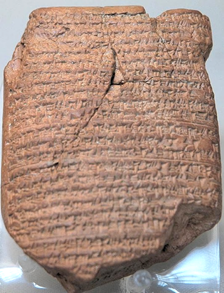
The “Nebuchadnezzar Chronicle” (ABC05) describes the early years of Nebuchadnezzar II (605-594 BC). Many such were found near Nineveh and are stored at the British Museum.

Normally it’s true that the victor writes the history all will remember, but that doesn’t seem to be the case for Babylon. The world over today knows the account of Babylon sacking Judah in 605, 597 and 586 BC based on the accounts of Jeremiah, Daniel, Ezekiel, 2 Kings and 2 Chronicles. Babylon’s version of the story wasn’t even known until after 1860 when the Babylonian Chronicles were found, a series of over 40 cuneiform clay tablets. After languishing on some back shelf in the British museum for decades, men began to decipher them, and the first set was published in 1887. Most interesting is the 5th set (out of 16 published thus far) called the Nebuchadnezzar Chronicle, pub-lished in 1956 by Donald Wiseman. It records three main events: The battle of Carchemish, where the king of Babylon defeated Pharaoh Necho of Egypt, in 605 BC; Nebuchadnezzar’s accession to the throne; and his capture and deportation of Jerusalem.

Here is how that clay Babylonian tablet (above) describes Egypt’s defeat and the king of Jerusalem’s capture: In the twenty-first year [604 BC] the king of Akkad [Nabopolassar] stayed in his own land, Nebuchadnezzar his eldest son, the crown-prince, mustered the Babylonian army and took command of his troops; he marched to Karchemiš which is on the bank of the Euphrates, and crossed the river to go against the Egyptian army which lay in Karchemiš. They fought with each other, and the Egyptian army withdrew before him. He accomplished their defeat and beat them to non-existence. As for the rest of the Egyptian army which had escaped from the defeat so quickly that no weapon had reached them, in the district of Hamath the Babylonian troops overtook and defeated them so that not a single man escaped to his own country. … In the seventh year [of Nebuchadnezzar, 597 BC], the month of Kislîmu, the king of Babylon mustered his troops, marched to the Hatti-land [Syria/Palestine], and besieged the city of Judah.  On the second day of the month of Addaru [March 16, 597] he seized the city and captured the king [Jehoaichin]. He appointed there a king of his own choice [Jehoiachin’s uncle Mattaniah, renamed Zedekiah], received its heavy tribute and sent to Babylon.

Next, we compare that with the Bible’s description in 2 Kings 24: “(6) So Jehoiakim slept with his fathers: and Jehoiachin his son reigned in his stead. (7) And the king of Egypt came not again any more out of his land: for the king of Babylon had taken from the river of Egypt unto the river Euphrates all that pertained to the king of Egypt. … (10) At that time the servants of Nebuchadnezzar king of Babylon came up against Jerusalem, and the city was besieged. (11) And Nebuchadnezzar king of Babylon came against the city, and his servants did besiege it. (12) And Jehoiachin the king of Judah went out to the king of Babylon, he, and his mother, and his servants, and his princes, and his officers: and the king of Babylon took him in the eighth year of his reign. (13a) And he carried out thence all the treasures of the house of the LORD … (14a) And he carried away all Jerusalem, and all the princes, and all the mighty men of valour, even ten thousand captives, and all the craftsmen and smiths … (15) And he carried away Jehoiachin to Babylon, and the king's mother, and the king's wives, and his officers, and the mighty of the land, those carried he into captivity from Jerusalem to Babylon. (16) And all the men of might, even seven thousand, and craftsmen and smiths a thousand, all that were strong and apt for war, even them the king of Babylon brought captive to Babylon. (17) And the king of Babylon made Mattaniah his father's brother king in his stead, and changed his name to Zedekiah.”

It's impressive how the accounts line up. Both capture the main points with the Bible providing more detail.  The only apparent disconnect is the number of years Nebuchadnezzar had been in power. According to the Jamieson, Fausset & Brown commentary, “the Hebrews computed the time when Nebuchadnezzar was associated with his father in government”, which the tablet mentions. This discovery delivered a serious blow to sceptics dismissing the Bible’s historical accounts as unreliable and inaccurate. God’s Word is still trustworthy!


Sources: Various sites noted by Wikipedia; plus Bible-history.com, Livius.org.

Like this? Consider sharing it to Facebook by clicking the linked icon below.

In 2 Kings 18:17, we read the king of Assyria [Sennacherib] sent Tartan and Rabsaris and Rabshakeh from Lachish to king Hezekiah at Jerusalem around 713 BC. Who were these people, and why did he send them?

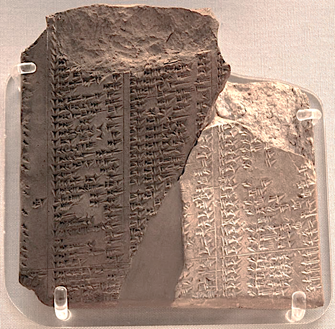
In 2 Kings 18:17, we read the king of Assyria [Sennacherib] sent Tartan and Rabsaris and Rabshakeh from Lachish to king Hezekiah at Jerusalem around 713 BC. Who were these people, and why did he send them? Since no classical Assyrian historian mentioned them, confusion as to their identity abounded, leading men to doubt God’s Word. Yet in 1847, vital insights about these men came from the Assyrian Limmu list. This artifact lists Assyria’s kings and events annually, as recorded by a selected high ranking official, called the Limmu (see MBC bulletin, July 17, 2022).

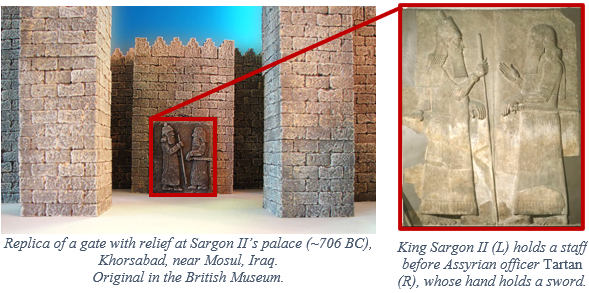
Tartan. The first named messenger sent to Hezekiah was Tartan, who worked for Sennacherib in 2 Kings 18, and for someone else in Isaiah 20:1a, where Tartan came unto Ashdod, when Sargon the king of Assyria sent him. Unbelieving and even faithful Bible scholars such as Dr. John Gill resolved the apparent contradiction by claiming Sargon, unmentioned by ancient historians, was Sennacherib.  However, with the discovery of Sargon’s palace in Khorsabad in 1843, no one today believes the two kings are the same (Sargon was his father).  It turns out that the Limmu for 856 BC is none other than Tartan, the chief of the army. Tartan is title meaning “commander in chief”, second only to the king.  Sargon II was depicted facing his Tartan on a nine feet tall gypsum bas relief (see below).

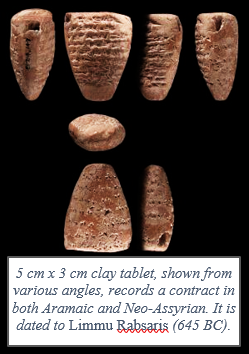
Rabsaris. The Bible records little of Rabsaris, and historians knew even less until a heart-shaped tablet was unearthed at Nineveh (right).  It records a contract where Hamatutu of Handuate got a 33% interest loan from the king’s son to obtain five homers of barley.  It was officially dated to “Limmu of Rabsaris Nabu-sar-usur” (or, 645 BC). This means Rabsaris is merely the title of a high-ranking Assyrian official, here named Nabu-sar-usur. While his exact role remains obscure, his title was apparently well-known that even the poor knew to reference him in a deal.
Rabshakeh. The Bible twice records Rabshakeh’s blasphemous words against the Lord, making him infamous among the ambassadors.  For centuries, no one knew about him either, until the Limmu list was deciphered.  The next after Limmu Tartan was Limmu Rabshakeh in 855 BC. He likewise was referenced by his official title and not his name.  He had some type of military role but could possibly have also been the king’s cupbearer. His knowledge of Hebrew implies a diplomatic office.

In summary, the Assyrian king Sennacherib appears to have sent his highest-ranking military general, official record keeper for the year, and top ambassador to king Hezekiah.  In 400 BC when Herodotus and Xenophon wrote what little knowledge of Assyria remained, these three officials were lost to classical history; however, the author of 2 Kings 18 did not write centuries after-the-fact, but as an eyewitness.  Furthermore, both Isaiah and Jeremiah prophesied of Judah’s exile into Babylon during a time when Assyria was the superpower, not Babylon.  Isaiah also wrote of Cyrus (Isaiah 44:28, 45:1) as a deliverer 150 years before his rise to power along with Persia’s subjugation of Babylon. The Bible’s historical accounts remain accurate, and its prophecies are not “post-dictions” but predictions. When will men quit doubting the veracity of God’s Word?  I am God, and there is none like me, declaring the end from the beginning, and from ancient times the things that are not yet done, saying, My counsel shall stand (Isaiah 46:9b-10a).

Sources: MindRenewers.com, AncientReplicas.com, & British Museum. Most explain Sargon II faces his son Sennacherib, but royalty hold scepters not swords.

Like this? Consider sharing it to Facebook by clicking the linked icon below.

One possible reason the 8th century prophet Jonah was missing (word hints in purple) from last week's chart of Hebrew and Assyrian kings is mainstream Biblical scholars view Jonah's account as "entirely ahistorical", a parody written hundreds of years after the fact and mistakenly interpreted as prophecy. Yet, an analysis of the Assyrian Limmu list discloses a greater miracle than Jonah's whale of a trip.

One possible reason the 8th century prophet Jonah was missing (word hints in purple) from last week’s chart of Hebrew and Assyrian kings is mainstream Biblical scholars view Jonah’s account as “entirely ahistorical”, a parody written hundreds of years after the fact and mistakenly interpreted as prophecy. Yet, an analysis of the Assyrian Limmu list discloses a greater miracle than Jonah’s whale of a trip.

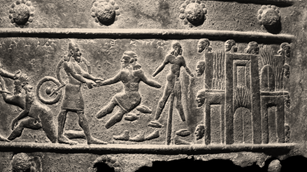
As you may recall, the list documents over a 1,000 years of royal Assyrian history, connecting social and solar events to a king’s annual reign. It meticulously recorded the Assyrian’s tradition of wars abroad. Every year the king went out on a campaign - not for votes, but for his enemies’ heads. Their treatment of captives was most gruesome, with a few examples memorialized in copper on an Assyrian gate at Balawat (see picture, right). 

Relief cast in bronze, Balawat Gate, depicting an Assyrian cutting off the hands and feet of a live captive while another is skewered on a pole.  Notice skulls on the walls. British Museum.

They would cut off their enemies’ hands and feet while still alive, rip off ears and tongues, or skewer them on long poles. They would flay them and drape the city walls with their skins. Some they would burn alive or decapitate them and hang their heads for all to see. One king wore a necklace of enemy skulls. This is in complete accord with Nahum 3:1 calling Nineveh the bloody city. Given their annual military expeditions to conquer and torture, you can see why Israel feared Assyria.

The prophet Jonah records his unusual but productive missionary trip, whose short message of God’s imminent doom caused 120,000 Assyrians from king to kine to repent. The Limmu list records something very peculiar happening in Assyria during this precise window of time. They stopped going to war!  Known as the 8th century “Period of Stagnation”, Shalmaneser IV had a continuous military campaign every single year throughout his reign for 37 years, followed by Ashur-dan III for another 4 years, who strangely stopped in 769 BC. All the way through king Ashur-nirari V, military campaigns happened only 8 out of 23 years.  There is no explanation for why “the king stayed in the land”. This is not Assyrian behavior; you either went to war or you were overthrown. God, however, records the Assyrian king’s response: let them turn every one from his evil way, and from the violence that is in their hands. (Jonah 3:8).  This also matches 2Kings 14:23-27, where God spared Israel under king Jeroboam II to give them one last chance to repent. Pacifist king Ashur-nirari V reigned 9 years before he was overthrown by the infamous Tiglath Pileser III.  Returning to old traditions, he and later Assyrian kings attacked and deported Israel from 740-722 BC (1Chronicles 5:26, 2Kings 17:3,6; 18:9-13).

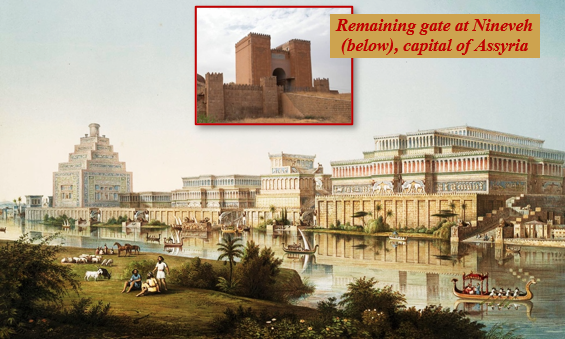
Other proofs of Jonah’s historical accuracy were found by Sir Henry Lanyard, discoverer of the Limmu list.  His extensive site surveys of Nineveh in 1845-47 noted an immense 8th century BC metropolis (see Lanyard’s depiction, 1853, below). 

Judging from four nearby city mounds, he traced a circumference of ~60 miles.  1st century BC Greek Historian Diodorus Siculus wrote Nineveh was 480 stadia (89 kilometers, or 55 miles) in circumference. 5th century BC historian Xenophon said her walls were 98 feet high and 49 feet thick, with a 2,000-acre city hub. If a man could walk 20 miles a day, Jonah’s description that Nineveh was an exceeding great city of three days' journey appears historically accurate. Once again, God’s record is right.


Source: https://armstronginstitute.org/312-jonahs-remarkably-accurate-account-of-assyria


Like this? Consider sharing it to Facebook by clicking the linked icon below.

Often in the Old Testament, the regnal dates of kings are recorded in a relative manner; for instance: And Nadab the son of Jeroboam began to reign over Israel in the second year of Asa king of Judah, and reigned over Israel two years.

Often in the Old Testament, the regnal dates of kings are recorded in a relative manner; for instance: And Nadab the son of Jeroboam began to reign over Israel in the second year of Asa king of Judah, and reigned over Israel two years. How can we know the absolute date of King Nadab’s reign based only on this information? The sad truth is we can’t, unless we have more correlated data. One of the Biblical archaeologist’s top 10 discoveries came in 1845–47, when Sir Austen Henry Layard made exploration and excavations among the Assyrian ruins of Nimrud and capital city Nineveh along the Tigris River. Among his most extensive treasure trove were ten cuneiform tablets (sample, right), listing consecutive years of Assyrian history tied to specific events and named after specific individuals. Known as the Assyrian Limmu list, it enables precise dating of Iron Age chronology for the kings of Assyria during the period of Israel’s kings.  It is widely agreed upon as highly accurate by both Biblical and secular scholars alike.
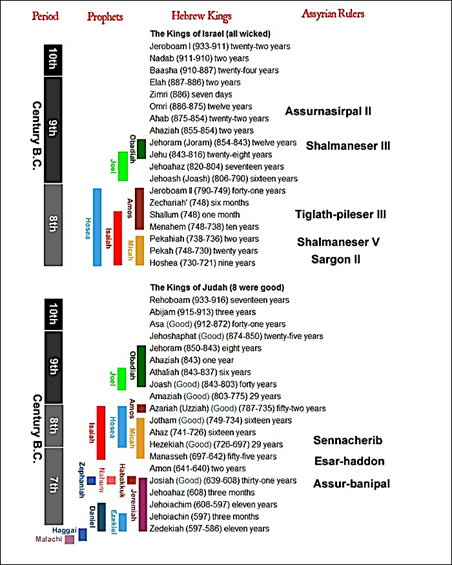
The Assyrians were obsessed with precise records, large library collections, and astronomy. (Remember, these pagans worshiped the host of heaven.) The Limmu was a high-ranking government official appointed once at the beginning of each solar year to document important annual activities. Main events noted included military campaigns, plagues, and astronomical events, such as Limmu Bur-Sagale’s solar eclipse, which they saw in Assur around the mid-8th century. Using astronomy dating methods, that eclipse dates to June 15, 763 BC, enabling an accurate chronology between 858 to 699 BC, which can be tied to the Bible’s records. Coupled with the extensive “Assyrian King List” tablets, one can reliably date over 1,000 years of history as far back as 1,964 BC.

The chart below gives absolute dates for eight Assyrian kings, 39 Hebrew kings and 14 prophets.  Can you find the one mistake (absence) in the chart?  The first who tells me gets a pint of fresh blueberries!

Info sources: Baylor University, BiblicalArchaeology.com, Britannica.com and Livius.org.  Chart (with mistake) from: Bible-History.com.  Photo from Livius.

Like this? Consider sharing it to Facebook by clicking the linked icon below.